AI Agents
Understand models, tools, instructions, memory, orchestration and controls — and how to choose between a chatbot, automation, workflow or agent.
Learn how to design AI-powered digital workers that can handle defined business tasks, use approved tools, follow your processes, escalate exceptions and create measurable business value — even without coding.
GET THE AI EMPLOYEEInstant digital access after successful payment
Escalations return to a person.
Most people use AI for writing, searching and brainstorming — then close the tab. Nothing repeatable gets built, so the same work comes back next week.
Not every task should be handed to AI. The book is explicit about this: it teaches bounded roles, approved tools, explicit limits and human escalation — not blind automation.
The book's core idea: the unit of automation should be a business responsibility, not a prompt.
Six parts that take you from the mental model to a supervised pilot.
Understand models, tools, instructions, memory, orchestration and controls — and how to choose between a chatbot, automation, workflow or agent.
Find the right workflow for your first automation, then map the work before automating it. Write the AI employee's job description and the SOPs behind it.
25 Ready-to-Adapt Prompts · Job Card Template · Workflow Mapping Worksheet · SOP Template · Testing and Security Checklists · ROI Worksheet · Register and Change Log · Weekly Review · Glossary
You want AI to create productive business capacity rather than simply generate text.
You want to identify repetitive work that could potentially be handled by supervised AI workflows.
You want systems that can support research, content, administration and client workflows.
You want to explore AI-powered workflows around enquiries, operations and customer interaction.
You want practical ideas for applying AI to sales, customer service, procurement and operations.
You want to understand how AI agents can fit into real work rather than simply learning AI theory.
This is a practical business book, not a programming textbook. You use its framework to:
The book is also clear that “AI employee” is a metaphor: an AI-enabled system that works within limits you set — software, not a human worker or an independent authority.
Instant digital access after successful payment
The book gives you a structured path for prototyping and piloting your first AI employee. It does not promise a result — it shows you how to test for one.
A week-long path from idea to supervised pilot.
Chapter 31A month-long, evidence-driven implementation plan.
Chapter 32Know whether the agent actually works.
Chapter 33Turn automation into a business case.
Chapter 34Monitor, review and improve the workflow.
Chapter 37Chapter openers, design questions, step-by-step workbook pages, common mistakes and chapter takeaways. These are real pages from the book.
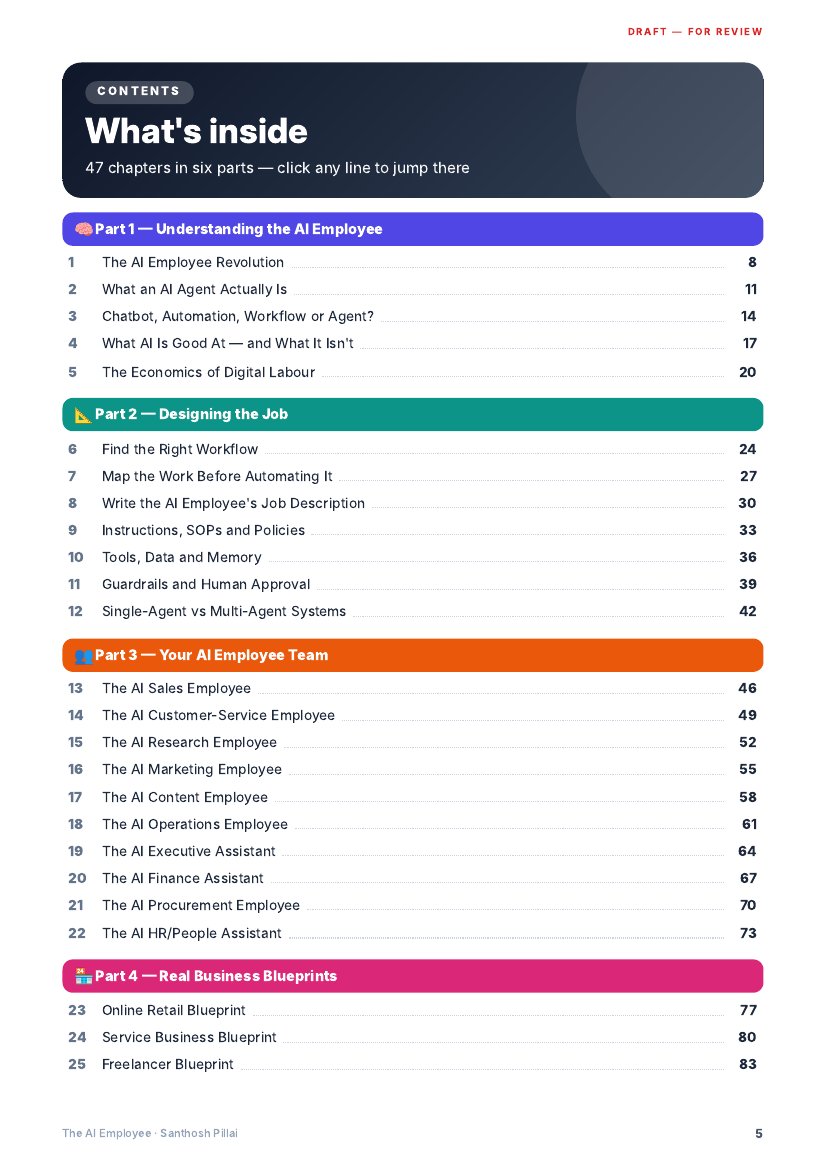
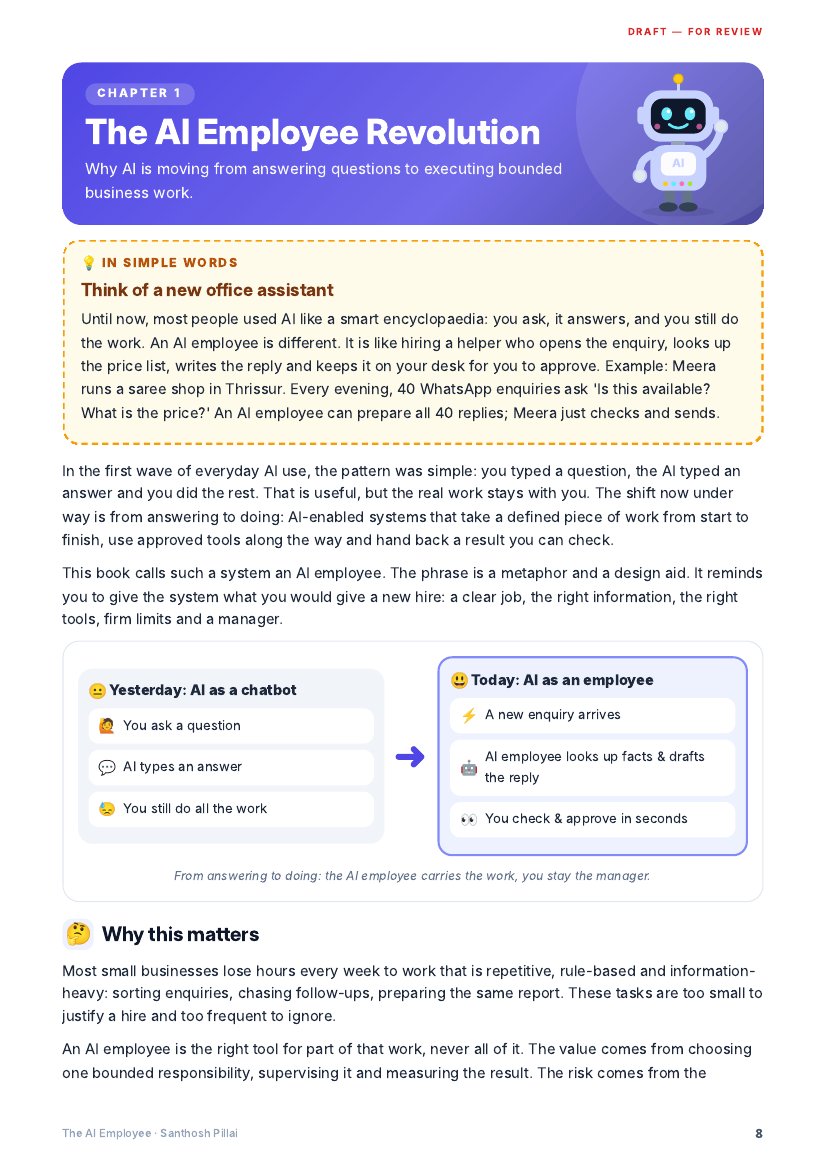
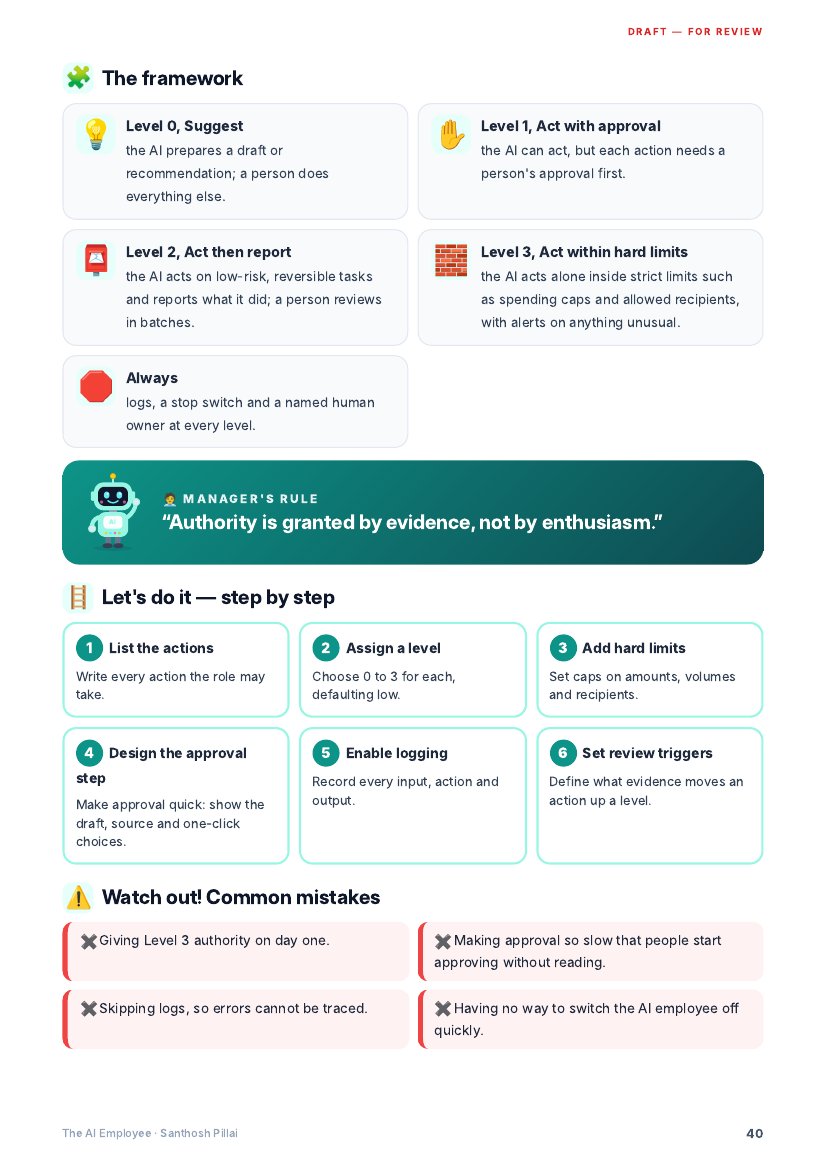
Designed to be used — not simply read.
The book closes with a toolkit part, built to be kept and reused as you design each new AI role. These are chapters inside the book — not separate downloads.
The book doesn't promote maximum autonomy. It treats limits as part of the design.
Mark which actions are automatic and which need approval. Give read access when read access is enough.
Design the stopping points that protect your business, and a clear way to hand difficult decisions back to a person.
Covers prompt injection and the risks that grow when AI can act, with a security checklist for deployments.
Test normal, incomplete, ambiguous and adversarial cases before granting more authority.
Compare speed, quality, cost and escalation, then review it every week.
A chapter on what goes wrong, why it happens and how to recover.
A good AI employee is not the one that does the most. It is the one that reliably does the right work within the right boundaries.— The AI Employee, Chapter takeaway
No. The book states that you do not need to know how to code to use its framework. It teaches you to identify useful work, define an AI role, connect information and tools, set limits, test performance and measure business value.
No. It is written for entrepreneurs, small-business owners, freelancers and professionals, with blueprints for online retail, service businesses, freelancers, technology resellers, small manufacturers and one-person companies.
No. It is a practical business book, not a programming textbook.
What AI agents are, how to choose the right workflow, how to write an AI employee's job description and instructions, how to connect tools and data safely, practical AI roles and business blueprints, a 7-Day Prototype and 30-Day Pilot, testing, ROI, failure modes, security and ongoing improvement.
Yes. It covers models, tools, instructions, memory, orchestration and controls, plus single-agent versus multi-agent systems and guardrails.
Yes. Ten AI role chapters (sales, customer service, research, marketing, content, operations, executive assistance, finance, procurement and HR/people) and six business blueprints.
It is written as a practical business guide and includes a beginner's step-by-step sequence for building your first AI employee. It's a framework for doing the work, not a promise that any reader will master the subject.
After successful payment you are automatically redirected to a Thank You page that contains your download link.
Digital ebook
Payment is completed on our payment gateway's checkout page · Instant digital access after successful payment
The AI Employee gives you a practical framework for identifying work, designing AI roles, building supervised workflows and measuring whether they actually create value.
GET THE AI EMPLOYEEInstant digital access after successful payment